More and more independent services are built on the Tredict OAuth API, and Beatpace is one of them. I like seeing this. :-)
In particular I find Beatpace very interesting and helpful, as it locks the BPM of the music to the workout steps planned in Tredict. Believe it or not, I very often find myself running with a metronome to practise a steady, calm cadence that locks to my planned pace. With Beatpace I can do the same, even better now! What a great idea.
So, Beatpace makes running music that follows your workout! The beat is locked to your cadence, and every block of a session runs at its own tempo, the warm-up at one tempo, the threshold work at another. Because Beatpace writes the music itself rather than pulling tracks from a playlist, the beat stays exact and never drifts.
Once you connect Beatpace to Tredict, it reads your planned training sessions and structured workouts through the Tredict OAuth API and builds the music for each session out of the workout itself. Beatpace's Tredict page lays out what gets read and how each step maps to the music.
Beatpace is made by Runner Twelve AB in Sweden.
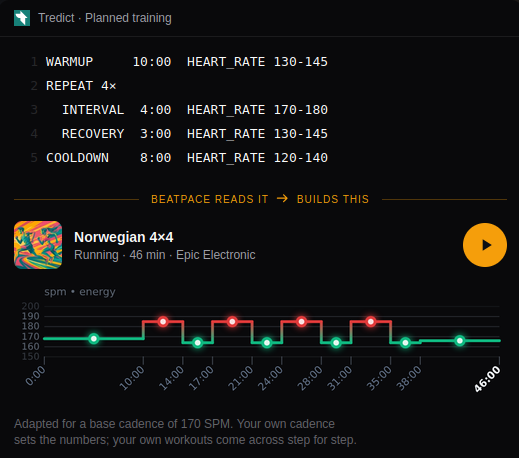
A workout planned in Tredict and the mix Beatpace builds from it. The BPM curve follows the structure of the session, faster through the intervals and calmer in the recovery.
Why does Beatpace work so well?
Beatpace uses auditory-motor synchronisation. Your footstrike locks to a steady beat on its own, without conscious effort, so the beat has to be clean and consistent. That is the problem Beatpace sets out to solve. BPM tags on streaming services are often wrong, and a track that drifts a few BPM by the chorus pulls your cadence along with it. So Beatpace generates the music itself, with a beat that holds its tempo and never drops out, and skips the build-and-drop structure that would break your form when you are tired.
Each planned session becomes one continuous mix, and every block in it carries its own exact BPM, matched to your cadence and scaled to the effort. Beatpace also cites research: synchronous music can lower perceived effort by around 10 per cent at submaximal intensities and help you hold cadence as you tire.
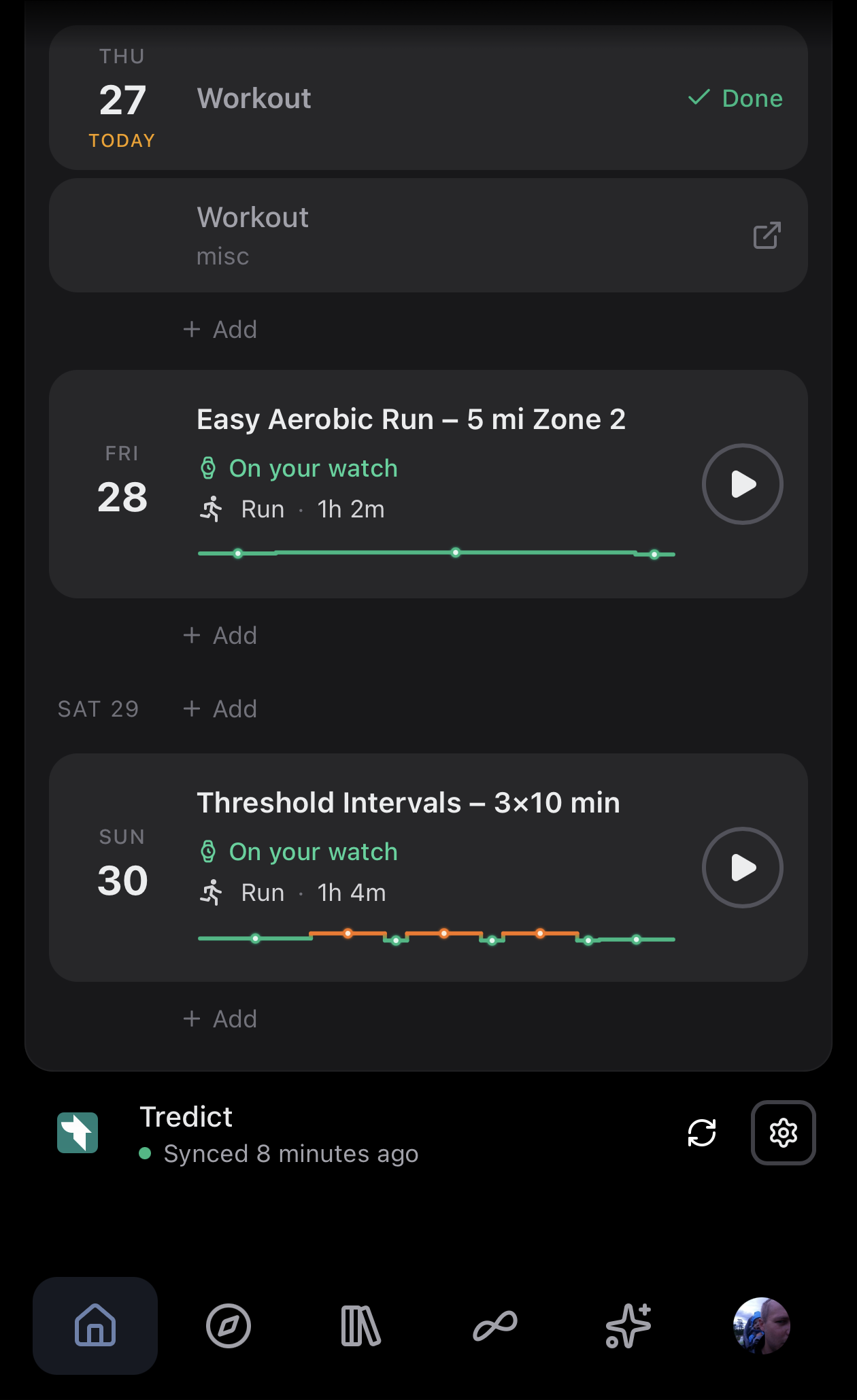
The Beatpace schedule view with planned trainings pulled from Tredict. Each workout has its own mix following the structure of the workout.
It plays in any browser, on a phone, tablet or computer. There is also a Garmin Connect IQ app, so on a music-capable Garmin you get wrist controls and offline playback, and you can leave your phone at home entirely.
Connecting Tredict and Beatpace
In Beatpace, you pick Tredict as your training-plan source and start the connection. Beatpace sends you to the Tredict authorisation page, you approve read access, and that is it. The permission can be revoked from inside Tredict at any time, and when you disconnect, Beatpace deletes the stored access tokens and your athlete id.
From then on, Beatpace reads your list of planned trainings, the structure of each workout with its cadence, and the maximum heart rate from your capacity data. It looks about ten days ahead and keeps your next three sessions built and ready. The plan refreshes automatically every evening around 9 pm in your local day, on every Garmin watch sync, and whenever you press "Sync plan now" in the Beatpace settings.
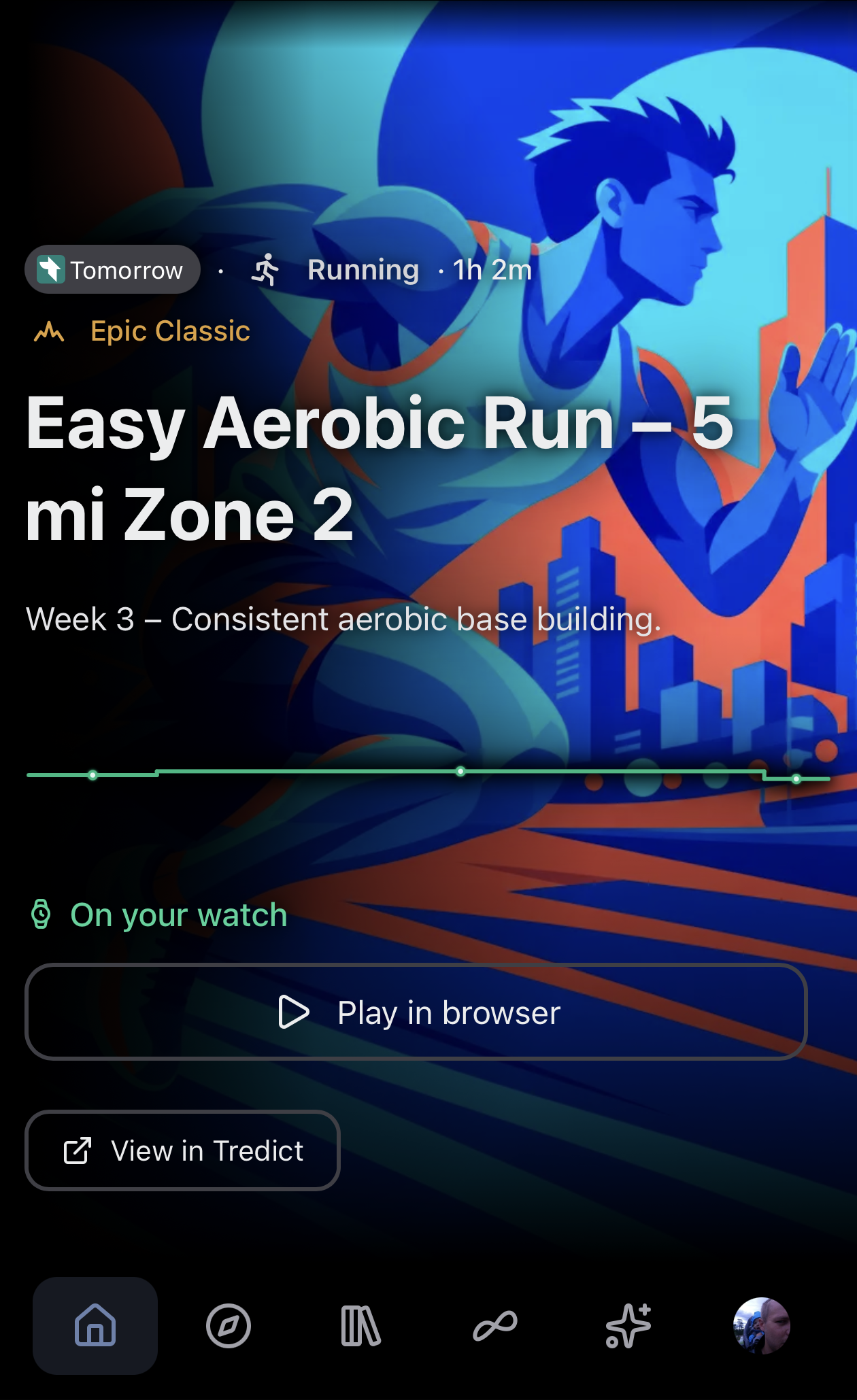
A workout planned in Tredict, ready to play as a cadence-locked mix in Beatpace.
How your workout steps become a cadence-locked mix
Beatpace reads the same structured steps you plan in Tredict and turns each one into a block of the mix:
- Duration: each step's duration sets the length of its block. There is no rounding to the nearest song.
- Intensity: Beatpace reads the step target as a percentage of the maximum heart rate Tredict holds for you. Under 80 per cent is Recovery, up to 92 per cent is Work, above that is Push. A step without a heart rate target takes its band from its type, so a warm-up, interval, recovery or cool-down still lands in the right place.
- Cadence: the tempo follows the base steps per minute you set in Beatpace, scaled to the effort of the block. A cadence target on the step itself takes priority.
- Distance steps: a step defined by distance is converted to time at the speed Tredict resolves for it, so the block matches what Tredict shows.
- Repeats: a repeat around an interval and its recovery becomes a single repetition block in the mix.
This works the same whether you plan the session yourself, your coach plans it, or an AI assistant creates it through the Tredict MCP Server or the Tredict ChatGPT Plugin.
Felix Gertz
Felix is the founder and developer of the endurance sports training platform Tredict. Since 2020, Tredict has been valued as a platform for training analysis and planning by endurance athletes and coaches around the world.