In discussions about modern training metrics, the question occasionally comes up of why Tredict does not calculate W' (pronounced W-Prime), when other platforms such as TrainingPeaks and WKO5 or Intervals.icu offer the concept. The answer is not that we overlooked it. We looked at it carefully and made a deliberate decision not to offer it in this form.
What W' actually is
W' describes anaerobic work capacity, the amount of energy in kilojoules that an athlete can draw on above their Critical Power before reaching exhaustion. Critical Power is the output at which metabolism remains just barely in balance. A cyclist with a CP of 250 W can ride at 240 W for hours. At 260 W, the clock starts, and after 20 to 30 minutes it is over. Everything above CP draws from a finite anaerobic reserve. Combined with the critical power model, this reserve yields a live metric called W'-Balance, which models that reserve in real time during a workout.
It sounds elegant, and in theory it is. In practice, though, the concept has problems that are rarely mentioned in the general discussion around W-Prime.
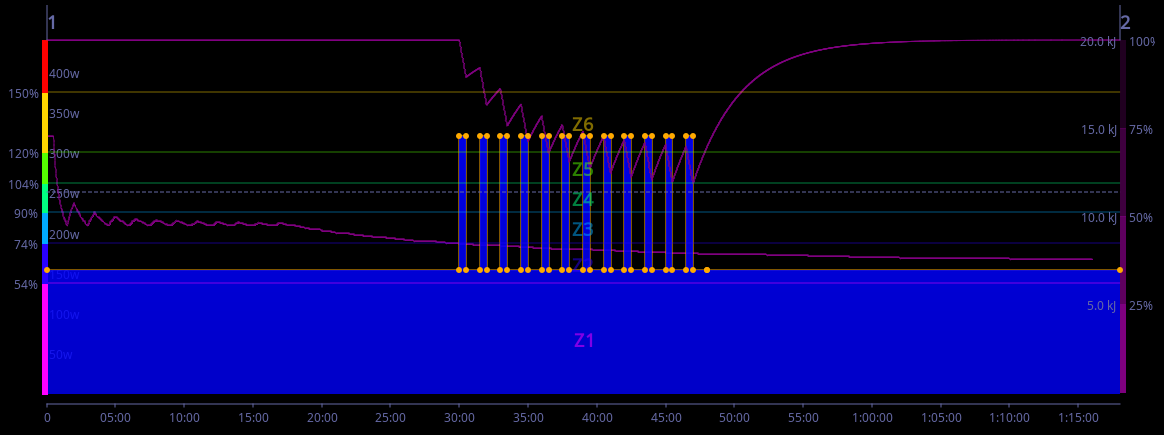
W-Prime, the upper purple curve, shown in GoldenCheetah for an interval session planned in Tredict. The active sections are visibly above 120% of Critical Power.
Problem 1: Practical usefulness is limited
W' is a conceptually elegant but practically narrow tool. It is only useful in situations where an athlete repeatedly and deliberately exceeds their Critical Power and manages the anaerobic reserve like a battery budget.
In cycling, this applies mainly to disciplines with repeated intensity swings above CP, such as track cycling or pursuit racing. In running, it applies to track middle distance, that is 800 m to 3000 m, and with some reservations 5K, where W' is theoretically relevant but not really tactically manageable. In these disciplines the anaerobic contribution is genuinely 15 to 30%, the athlete is deliberately operating above CP, and good W' management can determine, say, the final 200 m. Here, optimal W' distribution can theoretically yield 1 to 2% more performance.
The effort required for a correct calculation is considerable. Regular maximal efforts across multiple duration ranges to maintain the model, repeated several times a year. A power meter for running or cycling, calibrated and consistent. An athlete who has understood the concepts and can apply them tactically in a race. Plus a training setup that supports this kind of diagnostics. Olympic candidates, World Cup track cyclists and well-supported licensed riders go to this trouble. At a world-elite track sprint eliminator, those 1 to 2% separate a gold medal from fourth place. At a local middle-distance championship, they are statistical noise against daily form, sleep and course conditions.
For the typical Tredict user, things look different, even with a running power meter like Stryd. A 5K is run slightly above Critical Power, roughly 103 to 105% CP, but the effort is essentially constant across the entire distance. There are no tactical phases where W' is drawn on deliberately and then recharged, just a single slow burn across the race duration. W' is relevant at 5K in that sense, but as a one-dimensional quantity rather than a manageable budget. At 10K, half marathon, marathon and long-distance triathlon, race pace sits below CP, the tank stays full, and W' is not a limiting factor at all. In trail and mountain running one could argue that steep climbs nibble at W', but the established pacing advice there is precisely not to draw on the anaerobic reserve deliberately, but to take climbs slowly enough to stay aerobic.
It is also worth noting how Stryd, the most established running power meter, handles the concept. Stryd centres its official software entirely around Critical Power. A classic W' or D' display as a point estimate for anaerobic work capacity does not exist in PowerCenter. What does exist are related quantities such as "Muscle Power" (peak power over 10 seconds) or a "Fatigue Factor" in the Race Power Calculator, which characterises the slope of the power-duration curve. These quantities are conceptually similar but deliberately packaged differently. Stryd has not adopted the classic W'-battery logic as found in WKO5 or Intervals.icu, even though the underlying data would allow it.
What remains is a narrow application domain covering track middle-distance runners, track cyclists and competitive cyclocross riders. A group rarely represented among the endurance athletes and coaches who use Tredict.
One could object that W' is also useful in training, for dosing intervals against a defined anaerobic budget or for tracking anaerobic capacity as a trend separate from CP. That is true in principle, but this use leans on exactly the same model. It inherits the measurement and stability problems described below, so the value it delivers in practice is far rougher than a precise kilojoule figure suggests.
The next three problems explain why even within this small group, the metric often does not deliver what is suggested.
Problem 2: Measurement is hard
A reliable W' determination requires maximal efforts across multiple duration ranges, classically a 3-minute all-out and a 12-minute all-out. Not threshold intervals or tempo runs, but genuine maximal efforts. Most athletes rarely do this deliberately, and even those who do it once would need to repeat it regularly, because W' changes with fitness.
Without clean maximal efforts, a linear regression on non-maximal data will still produce a result with a high R², meaning the formula fits the data, but that result is mathematical theatre, not a physiological measurement. Software that simply outputs a value in this situation is implying a precision that does not exist.
Problem 3: W' is not stable over time
Even a correctly determined W' fluctuates with daily form, fatigue, glycogen status, sleep quality and heat. A value from two weeks ago can be completely wrong today. The live W'-Balance display shown on some head units is therefore false precision. It shows a figure to two decimal places whose real-world uncertainty runs into double-digit percentages.
Problem 4: The model variants contradict each other
There are several competing calculation variants for W'-Balance, each with its own tau constant for the recharge rate. Skiba 2012, differential Skiba, Bartram, Froncioni-Skiba-Clarke. In comparative studies, prediction errors frequently differ by 20 to 40%. Which variant is "correct" has not been scientifically settled.
What Tredict does instead
Tredict invests in metrics that are actionable for its actual target audience of endurance athletes. These include form and fitness based on the Banister model with compensation logic, individual capacity revisions, automatic FTP/FTPa determination from real training data, redundant effort calculation across three data sources, and programmable custom fields for athletes and coaches who want to build their own metrics. In preparation are an improved FTP/FTPa estimate with an honest confidence indication, and decoupling and durability indicators that provide a direct training lever for longer events.
These metrics share a common thread. They can be derived from the data athletes already produce, they are robust against data gaps and outliers, and they give coaches and athletes answers to questions that actually come up in day-to-day training.
For those who want to try it anyway
There is an elegant solution. GoldenCheetah is open-source analysis software that offers the complete critical power model including W', W'-Balance, several model variants and a live trace per activity. Anyone who wants to work with the concept will find exactly that there.
From GoldenCheetah 3.8, already available via a snapshot build, Tredict is integrated directly as a sync source in both directions. Activities from Tredict are imported into GoldenCheetah, analysed there, and can be synced back if needed. Nobody who genuinely wants to use W' has to go without it. Tredict remains the platform for training management, GoldenCheetah complements it for the analytical depth where W' actually makes sense.