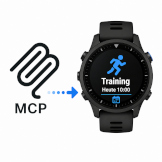
More and more platforms promise to hand your training data to an AI assistant. Yet these offerings differ enormously in what they actually let you do in the end. This article goes through nine points where Tredict differs. If you are looking for the step-by-step guide, from the first connection to the finished plan on your watch, start with how to connect Garmin with ChatGPT and Claude.
Tredict imports your entire training history, not merely the last 30 days. You therefore have your full training background to hand for analysis and planning.
Structured workouts and reusable training plans are built in Tredict and sync fully automatically through the official interfaces of your device manufacturer. Delete them and they are cleanly removed from your watch and calendar.
Per-second time series for heart rate, power, pace and cadence, alongside ready-made analysis metrics such as effort, capacity and zones, plus HRV, sleep and body data. Whichever AI you use, e.g. ChatGPT or Claude, it has detailed, comprehensive data to plan with.
Where the differences lie
In short, Tredict receives your completed sessions through the official APIs of Garmin, Coros, Suunto, Wahoo, Polar, Zwift and other manufacturers, and sends structured workouts back to your watch and calendar. AI assistants such as Claude, Grok, Perplexity or Mistral join through the "Tredict MCP Server", ChatGPT through the "Tredict ChatGPT Plugin".
This article is about the differences that only show up on closer inspection. Does the AI see your whole training history or just the last few weeks? Can it only read, or can it also write workouts and entire plans back to your watch and remove them again cleanly? Does it get per-second time series or merely averages? And how many parties handle your data on the way? These are the points where the available solutions part ways, and the following sections go through them one by one.
- Connect ChatGPT with Tredict
- Connect Claude with Tredict
- Connect Grok with Tredict
- Connect Perplexity with Tredict
- Connect Mistral with Tredict
- Connect your own MCP client with a personal API token
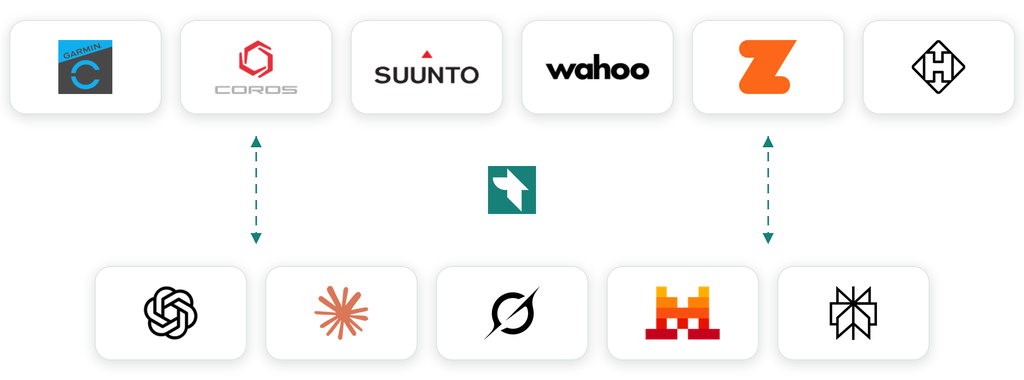
Through the official interfaces of Garmin, Coros, Suunto, Wahoo, Zwift and Hammerhead, Tredict connects the AI assistants ChatGPT, Claude, Grok, Mistral and Perplexity. In both directions!
Both directions, not just reading
The real value of an AI chat connection only emerges once the AI does more than read, and writes back as well. With Tredict, an AI such as ChatGPT or Claude can not only summarise your activities and answer questions about your training, but also deliver its result as a finished session back onto your watch.
With the "Tredict MCP Server", the AI creates structured workouts and entire reusable training plans that can span several months if you wish. These workouts and plans sync fully automatically to Garmin, Coros, Suunto, Wahoo, Zwift, Hammerhead or icTrainer, and to several of them at once should you use more than one device, since Tredict is vendor-neutral. The article Coros AI Training Plans and Workout Analysis with ChatGPT, Claude and Perplexity shows how it works with Coros, for example.
The distinction between a single workout and a reusable training plan matters here, and so does the way back. Tredict can load complete plans onto the devices and withdraw individual sessions as well as whole training plans whenever you, a coach or your AI rearrange something. The affected workouts are removed from the watch and from the manufacturer's calendar, and no duplicate entries are left behind.
If you are a coach, you can build up a whole library of reusable training plans with the help of ChatGPT or Claude, then apply them to an athlete as needed, to suit each use case.
Your complete training history instead of a 30-day window
Tredict imports your complete training history, not just a short 30-day look-back window. This applies to Garmin and broadly also to Coros, Wahoo, Polar, Zwift, Hammerhead, Suunto, Concept2 and Rouvy. This means you have a comprehensive training background for analysis and planning, from your first recorded sessions right up to today.
Per-second time series and ready-made analysis values
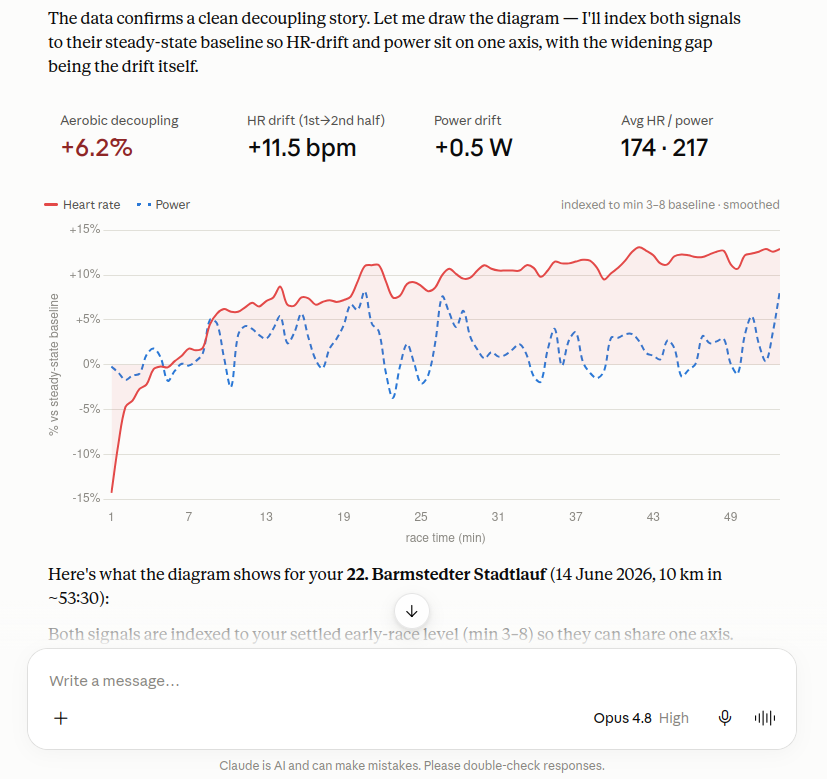
Claude visualises the cardiac drift of an activity in a chart, rendered from the per-second time series that the Tredict MCP Server provides.
Two questions decide how much an AI can do with your training data. How many metrics does it get at all, and at what resolution? Breadth and depth, in other words. Through the "Tredict MCP Server", the AI gets both on request rather than a summary line per activity.
First, there are the per-second time series of your activities. Heart rate, speed, power, cadence, elevation and position, together with running dynamics such as ground contact time and ground contact balance, as well as Stryd-specific figures like leg spring stiffness. The AI therefore sees more than just the average and can tell how your power faded in the third interval or how your heart rate responded to the climb.
Second, it draws on the analysis values that Tredict computes on top of the measured data, from effort and capacity values such as FTP and lactate threshold through your individual zone model and the zone distributions across weeks and months to HRV, sleep and body data. The article From your Garmin training to an AI training plan on your watch describes what each of these values contains.
The point for the comparison is that the AI gets both layers, raw measured data and ready-made analysis values. That separates planning through Tredict from a plain conversation with ChatGPT or Claude about your training. The test Six AI models determine my running FTP and so do I shows how well it works in practice. There I had Opus, GPT, Kimi, Gemini and Sonnet compete against one another. More recently I have had good results with Grok as well.
Through official manufacturer APIs, with no middleman
Every device integration runs through the official APIs of Garmin, Coros, Suunto, Wahoo, Zwift, Polar and others, maintained for years.
Tredict's built-in MCP server is subject to the same data protection terms as Tredict itself. No opaque data aggregator passes your data on, and nowhere do you sign in to an untrustworthy third-party service with the credentials of your watch manufacturer.
Tredict is GDPR-compliant, comes from Germany and is at home in a German data centre.
Tredict's device integrations are built throughout on the official manufacturer APIs and have been maintained for years. This holds for Garmin, Coros, Suunto, Wahoo, Polar, Zwift, Hammerhead, Concept2 and many more.
The route from the AI to your watch therefore needs only a handful of parties, the AI, you, Tredict and the device manufacturer. With other solutions another party often wedges itself in between, and in one of two ways. Either a service lacks its own integration with a manufacturer such as Zwift or Coros, so that a data aggregator like Terra.co passes your data on instead. Or it lacks an MCP server of its own, in which case a separate MCP server steps in between the AI and the service. Tredict provides both itself, the official integrations and its own MCP server, and in the case of ChatGPT even the fully official "Tredict ChatGPT Plugin", so it manages without this extra party. And nowhere do you sign in to a third-party service with the credentials of your watch manufacturer, since the connection runs through the manufacturer's official authorisation.
Tredict is GDPR-compliant, comes from Germany and has data protection terms that are properly drawn up and enforced. Tredict does not use AI systems to process your data and does not use your data to train AI models. So you use Tredict with the AI of your choice, not the other way round.
A practical side effect of vendor independence concerns your state of fitness. With the Training Effort tool, Tredict offers a vendor-neutral assessment of your load and recovery that takes HRV and sleep into account. This value stays with you if you ever switch watch brand, and remains comparable even many years from now.
Free choice of AI provider
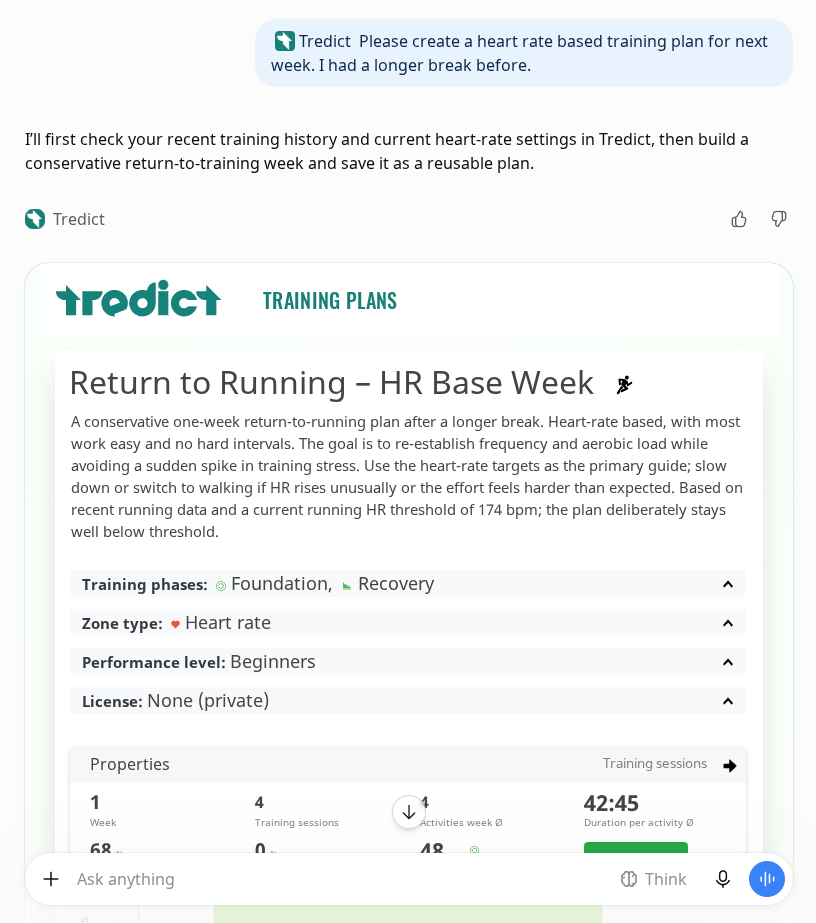
ChatGPT creates a reusable training plan that you can then apply in your calendar and that syncs to your watch automatically.
Tredict does not tie you to a single AI. The "Tredict MCP Server" is a dedicated, continuously maintained service with prepared OAuth access, so you connect Claude, Grok, Perplexity or Mistral in a few clicks, without any local installation. ChatGPT connects through the "Tredict ChatGPT Plugin" in a single click, even with a free account. With a personal API token you can attach practically any MCP-capable client, be it DeepSeek, GLM ZCode, OpenCode or a model you run yourself.
All of these routes use the same Tredict tools. At your request, the AI accesses your history, your capacity values, zones, HRV and sleep data, and builds a plan from them that suits your state of fitness rather than handing you a generic template. If a different model suits you better next year, you switch the AI and keep your data, your analyses and your plans in Tredict.
The article From your Garmin training to an AI training plan on your watch sets out step by step how this works in practice, from the first connection through concrete example prompts to the finished plan on the watch.
A mature platform in the background
After that just 49 USD or EUR a year, paid in advance and with no subscription, around 4 euros a month. Sign up without a credit card, with extensive, permanent read access in the Tredict app and through the MCP activity list.
Since 2020 Tredict has been a mature planning and analysis platform for athletes and coaches. Your AI builds on this analytical foundation.
Garmin, Coros, Suunto, Wahoo, Polar, Zwift, Hammerhead, Concept2 and more come together in one vendor-independent platform. Change brand and your history and your analyses stay with you.
Perhaps the most important difference sits behind the AI connection. Since 2020 Tredict has existed as a full planning and analysis platform for endurance sport. Your AI, e.g. ChatGPT or Claude, therefore builds on a well-developed foundation for analysis and planning that coaches and athletes have been using for years.
Two further things make getting started easy. Tredict is remarkably inexpensive, 49 USD or EUR a year, paid in advance and with no subscription, which works out at around 4 euros a month. Signing up is non-binding and runs directly through Tredict, without the detour of a third-party login account and without storing a credit card. The two free months with full access thus come without any payment hurdle, and you keep permanent read access to your training calendar, in a limited form through the "Tredict MCP Server" too. For coaches Tredict is always free without full access, and the networking features let you view or edit the training calendars of connected athletes.
Now let's get going!
Tredict combines the full round trip, a complete training history, per-second time series and writing entire reusable plans to the watch, all through the official manufacturer APIs, without an interposed data service, and GDPR-compliant from Germany. Which AI you use is up to you. The "Tredict ChatGPT Plugin" connects ChatGPT in a single click and even with a free account, the "Tredict MCP Server" connects Claude and other AI assistants in a few clicks. Added to this are the two free months, the low price and the option to apply all of this as a coach across all your athletes.
Install the Tredict ChatGPT Plugin or connect Claude with Tredict.